
Why Are My Amazon Ads Getting Clicks but No Sales?
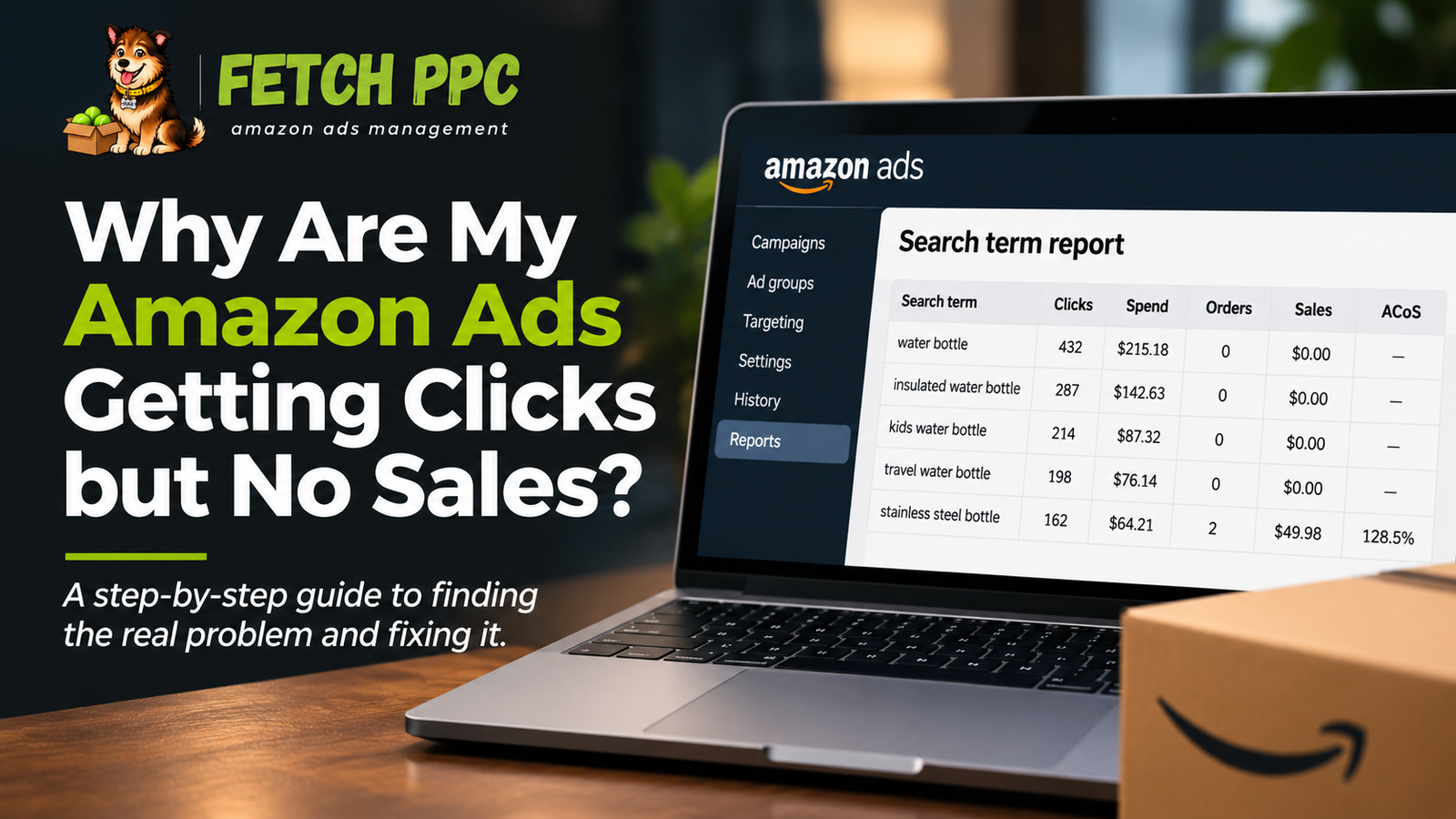
First, Make Sure You Have Enough Data
A handful of clicks without a sale is not necessarily a problem.
Products convert at different rates, and individual campaigns can have short stretches where traffic does not produce an order.
Before making changes, look at:
• number of clicks
• spend
• conversion rate
• average cost per click
• product price
• historical conversion rate
• search terms generating the traffic
If the campaign has only received a small amount of traffic, you may simply need more data.
If it has accumulated meaningful spend and clicks without orders, start digging.
Check the Search Terms
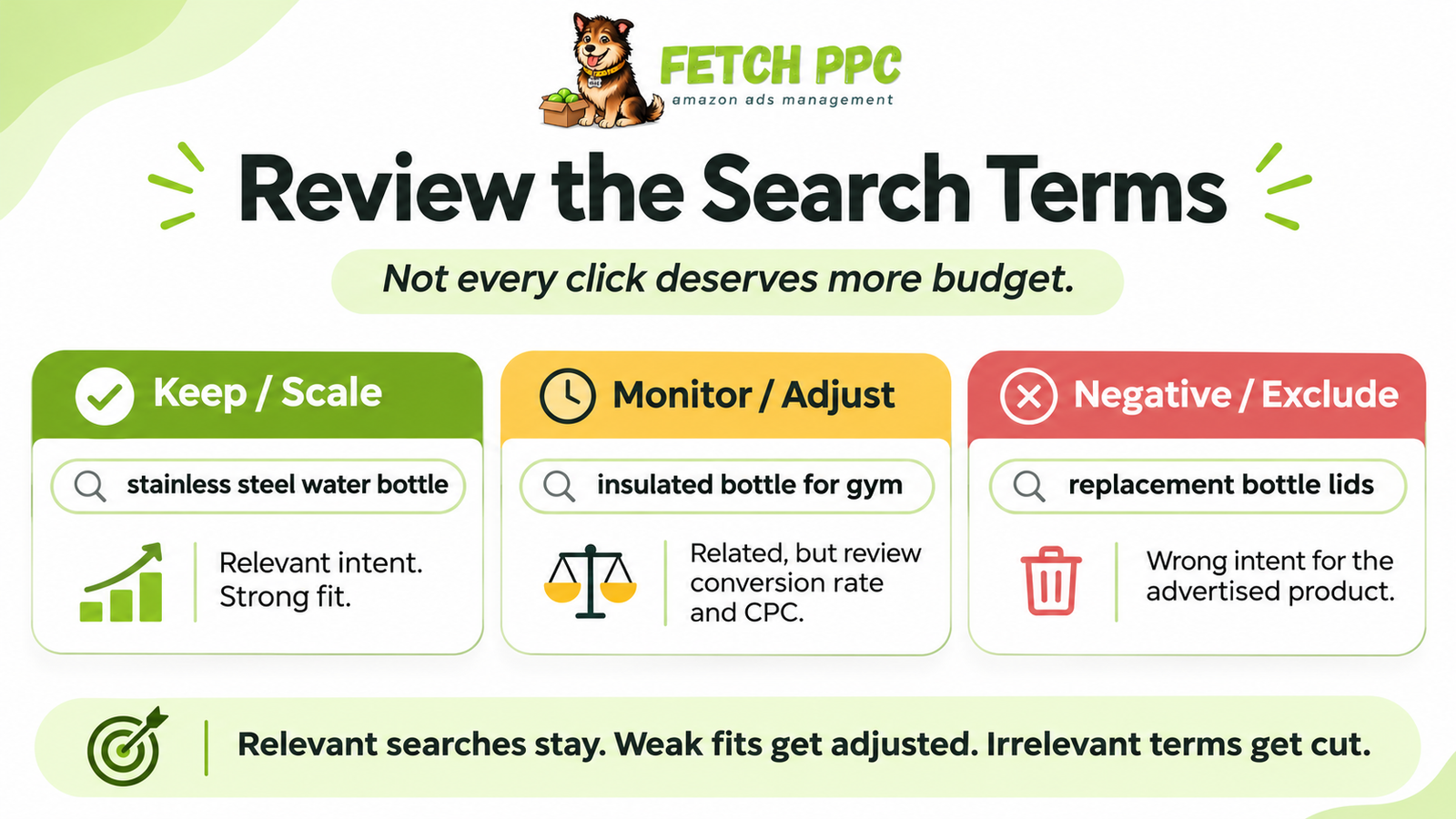
Search Terms is the first place I would look.
Your keyword may seem relevant while the search terms behind it tell a different story.
Broad and phrase match campaigns can expose your product to searches that are related to the keyword but do not match what the shopper wants.
For example, a campaign advertising a premium stainless-steel water bottle may receive clicks from searches for:
• kids water bottles
• glass water bottles
• insulated tumblers
• cheap water bottles
• replacement bottle lids
The traffic is related. That doesn’t mean the traffic is right for you.
Open the search term report and look for terms that are spending without producing orders.
Some may need to be:
• added as negatives
• moved into more controlled campaigns
• bid down
• separated from higher-performing terms
The goal is not simply to get fewer clicks.
The goal is to pay for more of the clicks that have a reasonable chance of becoming sales.
Look at Search Intent, Not Just Keywords
Two searches can contain similar words and represent very different shoppers.
Someone searching: “travel coffee mug” may be browsing broadly.
Someone searching: “20 oz stainless travel mug leakproof” is telling you much more about what they want.
That does not mean every long-tail search is better. It means the closer the search matches the product being sold, the more useful the traffic tends to be.
When clicks are coming in without orders, ask:
Would someone typing this search reasonably expect to find my product?
If the answer is weak, the targeting may be too loose.
Check the Product Detail Page
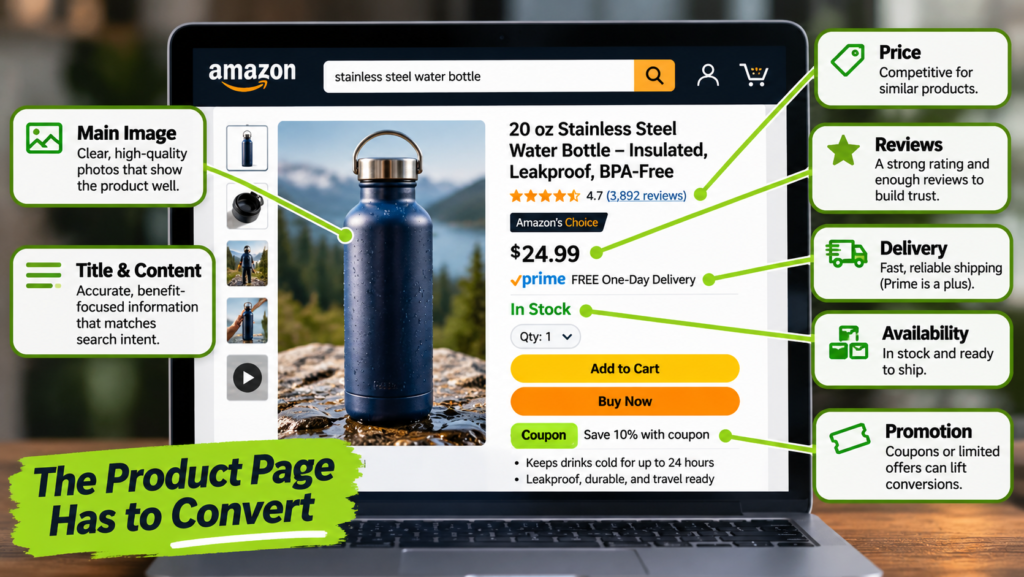
If the traffic looks relevant, move to the listing.
Your ad can win the click, but the product page has to win the sale.
Look at the page the way a shopper sees it beside competing products.
Pay attention to:
• main image
• additional images
• price
• reviews and rating
• title
• bullet points
• delivery timing
• coupons or promotions
• A+ Content
• variations
• availability
The issue does not have to be dramatic.
A competing product may have stronger reviews, a better primary image, a clearer feature set, faster delivery, or a price that makes yours harder to justify.
PPC can send qualified traffic to a product, but it can’t force that product to convert.
Compare Your Offer With the Search Results
Don’t only evaluate your listing. It’s time for some investigative research.
Search Amazon for the terms producing clicks and look at the products surrounding yours.
If your product sells for $79 and the results page is filled with comparable options at $39 to $49, shoppers may click because the product looks interesting and leave when they compare the offer.
The same applies to:
• review count
• star rating
• product features
• pack size
• perceived quality
• delivery
• promotions
Your ad is competing before and after the click.
The search results page earns the visit.
The product detail page has to justify the purchase.
Look at Placement Performance
Not every placement behaves the same way.
A campaign may perform differently at:
• top of search
• rest of search
• product pages
If clicks are accumulating without sales, look at where those clicks are coming from.
A placement producing strong conversion may justify a different bid strategy than one producing expensive traffic with weak results.
Do not treat the campaign average as if every placement contributed equally.
Review Product Targeting
The same principle applies to ASIN and category targeting.
A competitor product may appear to be a logical target but still send poor traffic.
The product could be:
• priced very differently
• aimed at another type of customer
• positioned around different features
• substantially more established
• purchased for a different use
Product targeting should be evaluated based on what shoppers do after clicking, not simply whether the targeted ASIN looks related.
If a group of product targets keeps spending without producing orders, it deserves attention.
Check Whether the Problem Is Bigger Than PPC
Sometimes the campaign is the messenger.
If paid traffic stops converting, check whether the product’s overall conversion has changed too.
Look for changes in:
• price
• inventory
• Buy Box eligibility
• delivery speed
• reviews
• ratings
• listing content
• competition
• promotions
If both paid and organic traffic are converting poorly, changing bids may not solve much.
The underlying issue may be the offer.
Do Not Increase the Budget to Solve a Conversion Problem
A campaign that spends its daily budget without generating enough sales does not necessarily need more budget.
More money gives the campaign more room to spend.
It does not make the traffic better.
Before increasing the budget, determine whether:
• the search terms are converting
• the product targets are working
• the bids make sense
• the placements are productive
• the listing converts qualified traffic
• the product economics can support more spend
If those pieces are working and the campaign is being constrained by budget, increasing it may make sense.
If they aren’t, fix the problem first.
What I Check When Amazon Ads Get Clicks but No Sales
I would work through the account in roughly this order:
• Is there enough data to judge the campaign?
• Which search terms are producing the clicks?
• Does the traffic match the product?
• Which placements are spending?
• Which product targets are spending?
• Is the product detail page competitive?
• Has the product’s overall conversion changed?
•Are bids or budgets pushing too much money into weak traffic?
That keeps you from changing five things at once without knowing which one mattered.
Clicks Are Not the Goal
Clicks tell you that the ad generated enough interest for someone to visit the product page.
While that is useful, the real value of the campaign comes from what happens after the click.
When Amazon Ads are getting traffic but not sales, the answer is usually found by tracing the following path:
Search → Ad → Click → Product Page → Order
Find where shoppers are dropping out, and fix that part of the system.
Need Help Finding Where Your Amazon PPC Is Breaking Down?
Fetch PPC manages Amazon advertising for established sellers who want clearer control over traffic, spend, targeting, and campaign performance.
An account audit can uncover search terms wasting spend, weak product targets, placement problems, budget issues, and areas where qualified traffic is failing to convert.
Contact us today, and we’ll get started with a conversation and a free account audit.