
How Much Should You Spend on Amazon Ads?
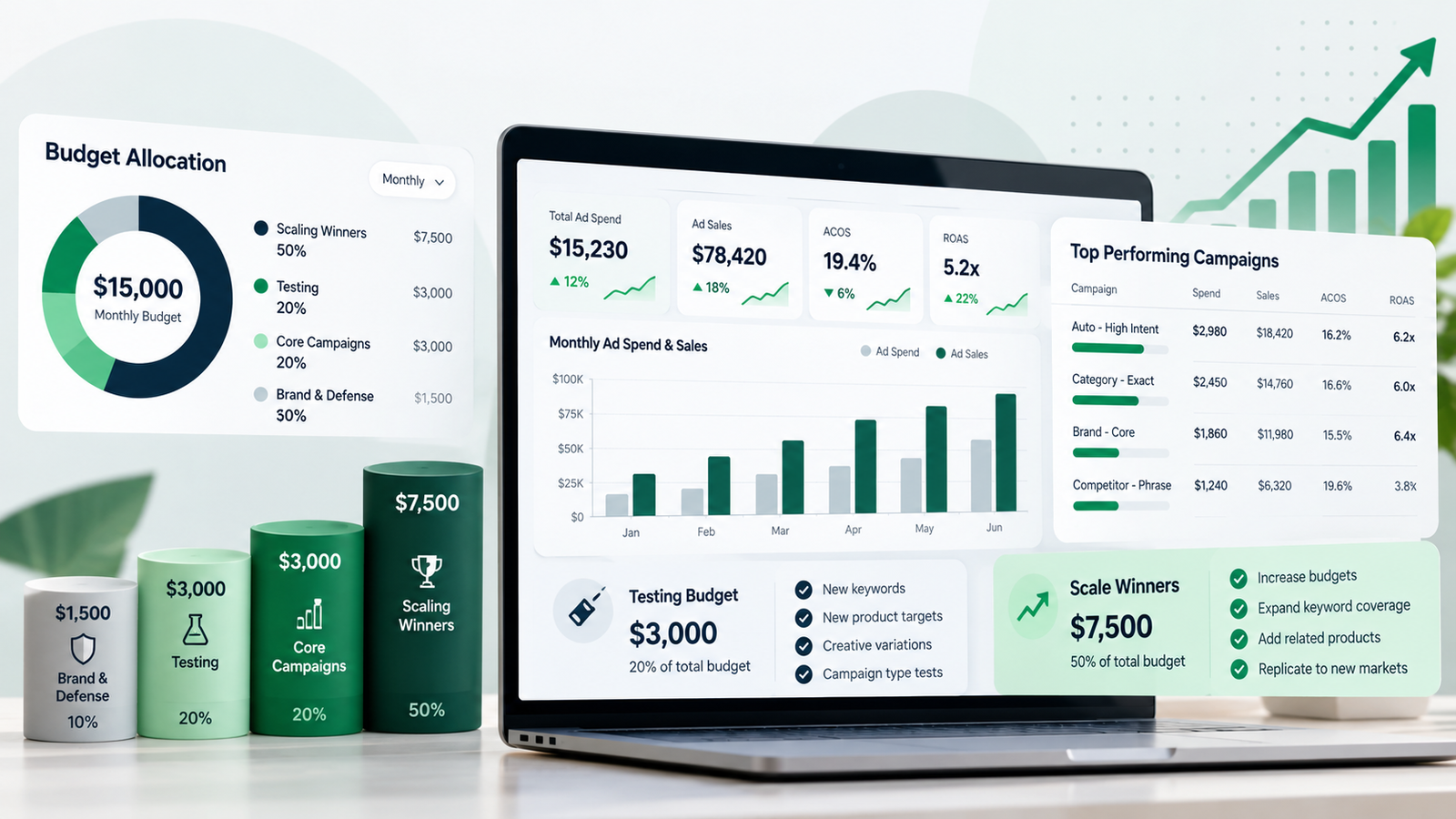
The right PPC budget depends on your margins, sales goals, cost per click, conversion rate, product maturity, and how aggressively you want to grow.
A better question is:
How much can I spend while still getting the return I need from this product?
That gives you something much more useful to build a budget around.
Start With the Economics of the Product
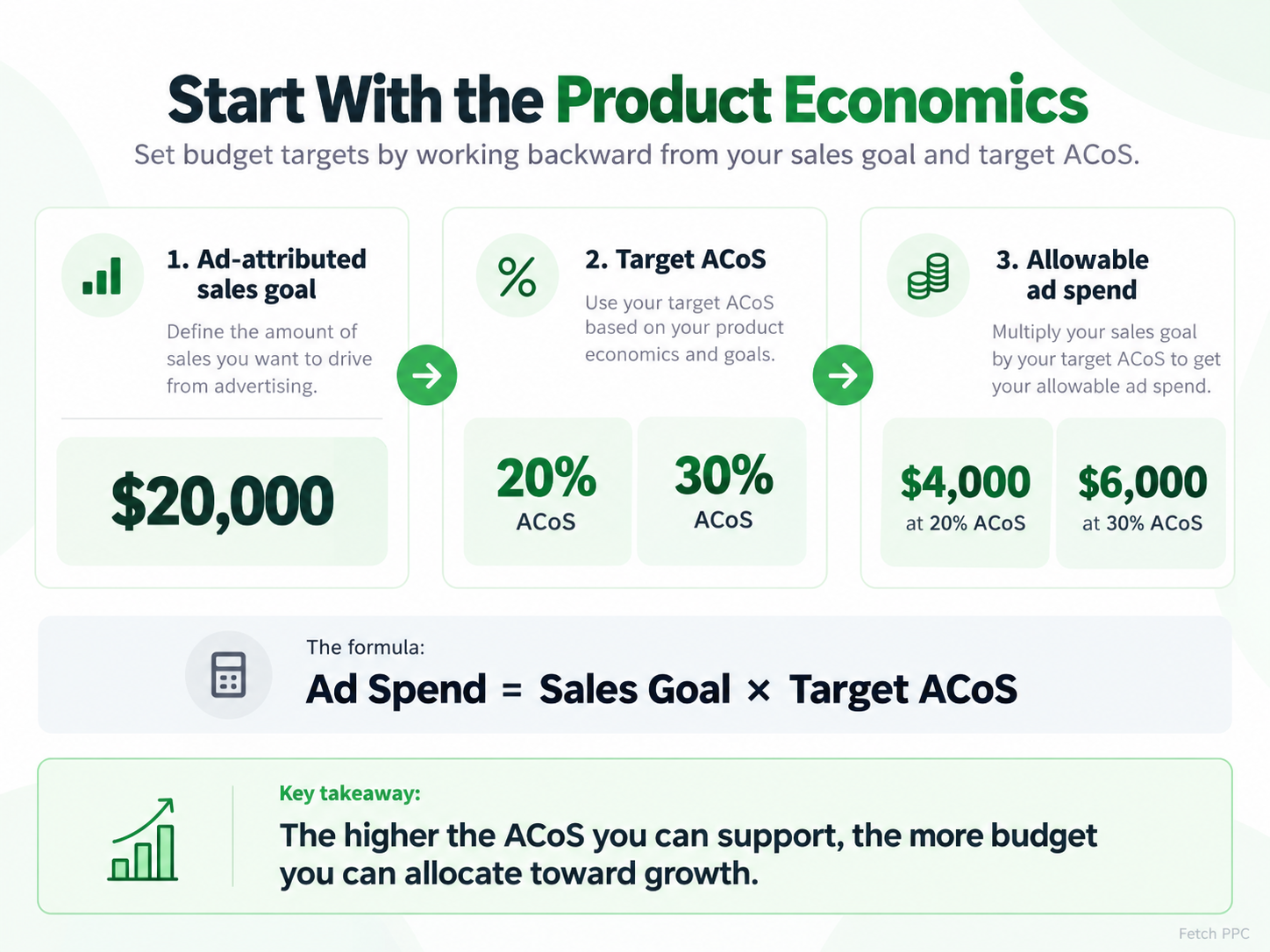
Before deciding how much to spend, know what the product can afford.
Suppose a product sells for $100 and your break-even ACoS is 30%.
If your goal is to generate $20,000 in ad-attributed sales, a 30% ACoS would allow up to:
$20,000 × 30% = $6,000 in ad spend
That is your break-even advertising spend at that sales level.
If you want the advertising itself to contribute more profit, your target ACoS needs to be lower.
At a 20% target ACoS:
$20,000 × 20% = $4,000 in ad spend
The sales target is the same. The amount you can afford to spend changes because the profitability goal changed.
This is a better starting point than picking an arbitrary daily budget.
Your Budget Also Has to Buy Enough Traffic
A budget can make sense financially and still be too small to learn much from.
Suppose your average cost per click is $2.
A $20 daily budget gives you room for roughly 10 clicks per day.
If the product converts at 10%, that amount of traffic may produce around one order per day on average.
With limited traffic, it takes longer to identify useful search terms, compare targets, and separate meaningful patterns from normal variation.
That does not mean every campaign needs a large budget.
It means the budget needs to be large enough for the campaign to do its job.
A campaign repeatedly running out of budget early in the day may be missing traffic that could have produced profitable sales. On the other hand, increasing the budget on a campaign that already spends inefficiently simply gives it more money to waste.
Budget follows performance. It does not fix performance.
Mature Products and New Products Need Different Budgets
A proven product usually gives you more information to work with.
You may already know:
• which search terms convert
• what the normal CPC range looks like
• the product’s conversion rate
• its break-even ACoS
• how paid sales relate to total sales
That makes budgeting easier.
New products are different.
A launch often requires enough budget to test search terms, product targets, bids, and placements before you know where the strongest opportunities are.
That may mean accepting a higher ACoS for a period of time.
The important part is making that a deliberate decision rather than allowing a launch campaign to spend indefinitely without a clear goal.
Do Not Spread the Budget Evenly
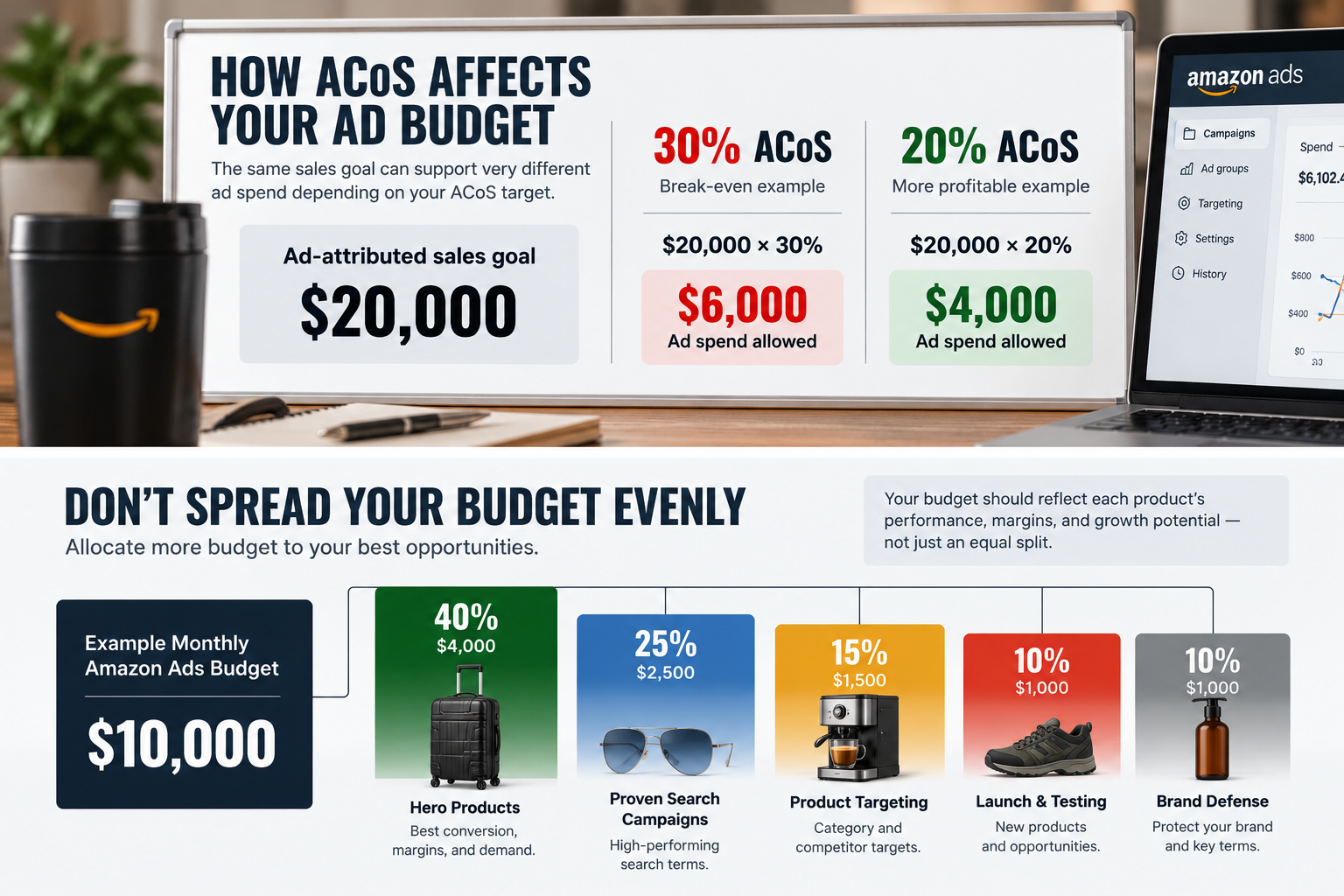
If you sell multiple products, dividing the advertising budget equally among them is usually too simplistic.
Some products will have:
• stronger margins
• better conversion rates
• more search demand
• better reviews
• stronger organic rankings
• more inventory
• greater growth potential
Those products may deserve more advertising investment.
Others may need to be restricted until pricing, inventory, listing quality, reviews, or conversion improve.
The same applies inside the campaign structure.
A proven non-branded search term should not necessarily receive the same budget priority as an experimental product target.
The budget should reflect opportunity.
Watch for Campaigns Limited by Budget
One of the clearest signs that a campaign deserves a closer look is when it consistently reaches its budget limit.
But “limited by budget” is not automatically a reason to spend more.
First look at what the campaign is producing.
If a campaign:
• consistently converts
• operates within an acceptable ACoS range
• supports an important product
• has additional available traffic
Increasing budget may make sense for these scenarios.
If it is already above your acceptable ACoS, spending more is unlikely to solve the underlying problem.
You may need to address search terms, bids, placements, targeting, or the product itself first• .
Budget for the Account, Then Allocate It
For an established seller, it can be useful to think about Amazon PPC at two levels.
First: How much are we comfortable investing in Amazon advertising this month?
Then: Where should that money go?
That second question matters just as much.
Your budget may need to cover:
• branded search
• non-branded search
• automatic campaigns
• product targeting
• Sponsored Brands
• product launches
• seasonal opportunities
• testing
Not every area deserves the same amount.
A strong account continually moves spend toward the places earning more investment and away from the places that are not.
More Budget Should Have a Reason
Increasing spend makes sense when there is evidence that additional investment can produce worthwhile sales.
Good reasons may include:
• profitable campaigns are regularly budget constrained
• an established product has room to capture more demand
• a new product has a defined launch strategy
• search-term data has uncovered new opportunities
• seasonal demand is increasing
• margins support more aggressive acquisition
“Sales are down” in of itself is not a reason to raise the advertising budget.
Neither is “we spent this much last month.”
The budget should follow the opportunity in front of the account.
So… How Much Should You Spend?
Start with four numbers:
1. Your product margins
2. Your break-even or target ACoS
3. The amount of sales you want advertising to generate
4. The traffic required to reach that goal
From there, build a budget that gives strong campaigns enough room to perform without treating every campaign as equally valuable.
The goal is not to spend as little as possible.
The goal is to put enough money behind the right traffic, products, and campaigns while keeping the economics of the account under control.
Get Help With Your Budget
Still not sure how to confidently set your budget? No problem!
Contact Fetch PPC today to request an account audit and see what’s possible for your campaigns.