
What Is A Good ACoS For Amazon Ads?
To rip the band-aid off right away, there is no universal “good” ACoS on Amazon.
A 20% ACoS may be profitable for one product and too high for another. The number only becomes useful when you compare it with your margins, your advertising goals, and the role of the product being advertised.
What Does ACoS Mean?
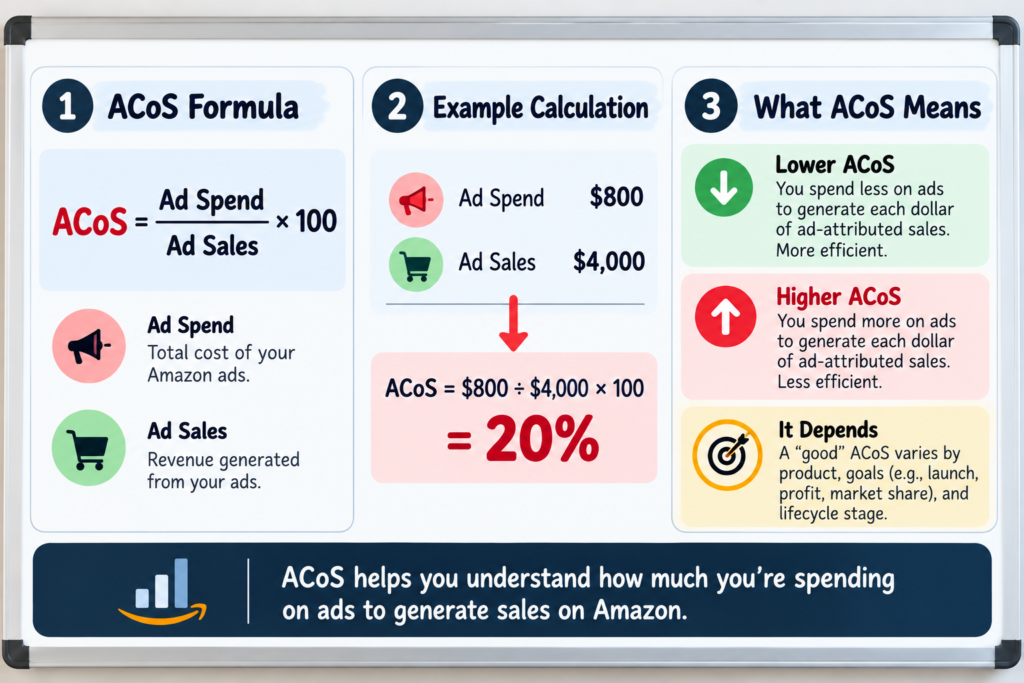
ACoS stands for Advertising Cost of Sales. It measures how much you spend on Amazon advertising for each dollar of ad-attributed sales.
The formula is:
ACoS = Ad Spend ÷ Ad-Attributed Sales × 100
If you spend $800 on Amazon Ads and generate $4,000 in attributed sales:
$800 ÷ $4,000 × 100 = 20% ACoS
You spent 20 cents on advertising for every dollar of attributed sales.
That tells you how efficiently the advertising generated revenue. It does not tell you whether the sale was profitable.
Start With Your Break-Even ACoS
Your break-even ACoS gives you a much better benchmark than an industry average.
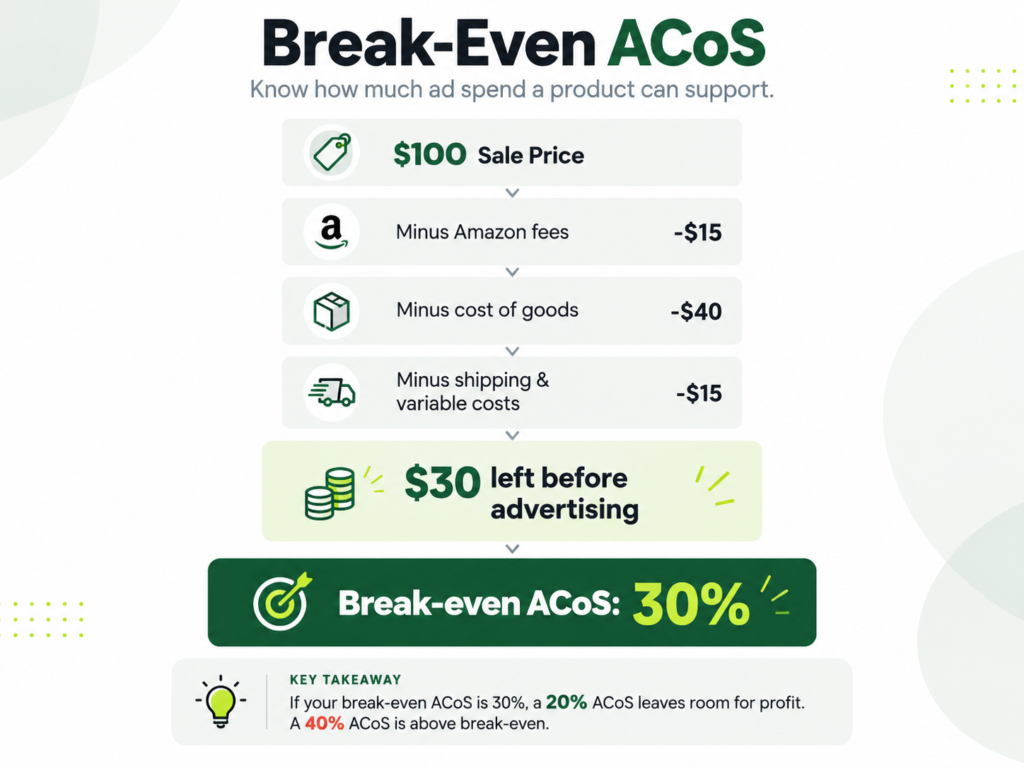
To keep it simple, suppose a product sells for $100. After product costs, Amazon fees, shipping, and other variable expenses, you have $30 remaining before advertising.
Your approximate break-even ACoS is 30%.
At that point:
• 20% ACoS leaves room for profit after advertising.
• 30% ACoS is around break-even.
• 40% ACoS is above break-even.
That does not automatically make a 40% ACoS a bad result. You may be willing to spend above break-even during a product launch, promotion, or another period where growth is more important than immediate advertising profit.
But you should know when you are doing it, and why.
Lower ACoS Is Not Always Better
A lower ACoS means you are spending less on advertising relative to attributed sales. That is useful, but it should not become the only goal.
Consider two campaigns:
Campaign A: $5,000 in sales at 15% ACoS
Campaign B: $20,000 in sales at 25% ACoS
Campaign A is more efficient.
Campaign B generates four times as much attributed revenue.
Depending on margins and business goals, Campaign B may be the more valuable campaign.
The same problem appears when branded search campaigns produce very low ACoS. Those campaigns may be efficient because shoppers were already looking for the brand.
A low ACoS looks good on a dashboard, but it doesn’t automatically mean the campaign is creating the most growth.
Your Target ACoS Depends on the Product
Even within the same Amazon account, different products may need different targets.
A mature bestseller with strong organic visibility may be managed primarily for profitability.
A new ASIN may run at a higher ACoS while you test search terms, build sales history, and find the traffic that converts.
A seasonal product may justify heavier spending while demand is strongest.
Products also have different margins. A target that works for one ASIN may not make financial sense for another.
For that reason, managing an entire account toward one ACoS target can hide more than it reveals.
Look at TACoS Too
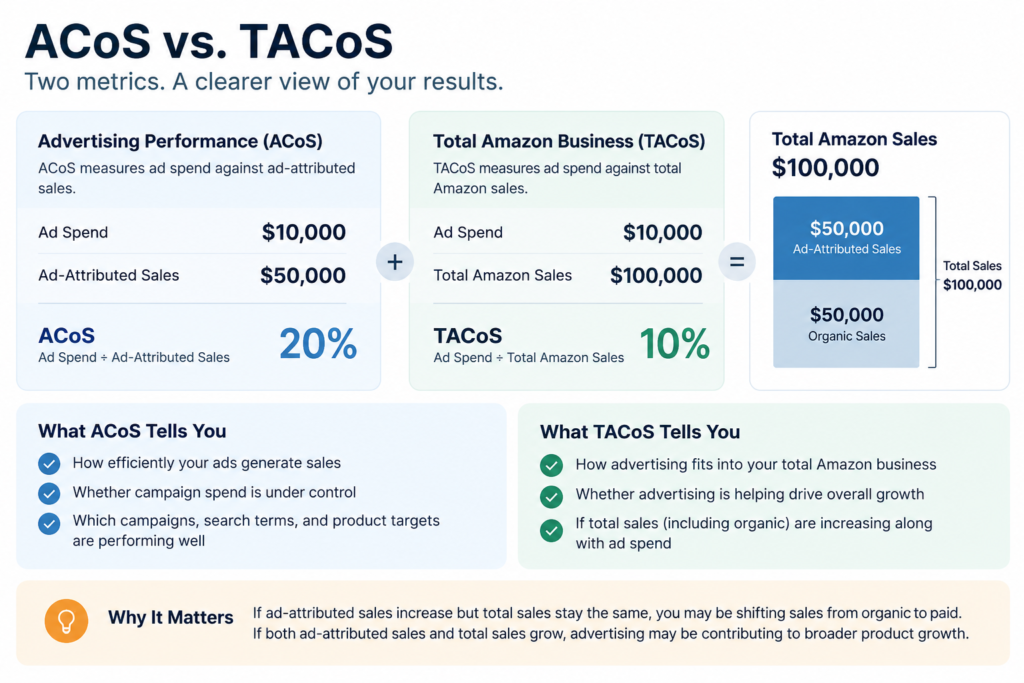
ACoS measures ad spend against ad-attributed sales.
TACoS measures ad spend against total Amazon sales.
The formula is:
TACoS = Ad Spend ÷ Total Amazon Sales × 100
Suppose you spend $10,000 on advertising and generate $50,000 in attributed sales. Your ACoS is 20%.
If total Amazon sales are $100,000, your TACoS is 10%.
Looking at both metrics gives you more context.
If ad spend increases while total sales and organic sales also grow, advertising may be contributing to broader product growth.
If ad-attributed sales rise while total sales barely change, paid traffic may be taking a larger share of sales without producing much additional growth.
ACoS alone will not show you that.
Account-Wide ACoS Can Hide Problems
An account may show a 24% ACoS while the campaigns underneath it look very different:
• Branded campaigns: 9%
• Established product: 18%
• Non-branded search: 31%
• New product launch: 47%
• Product targets spending without enough sales
The 24% average is not wrong. It is just incomplete.
The more useful questions are where the spend is going, what each campaign is supposed to accomplish, and whether the results justify the investment.
So… What Is a Good ACoS?
Back to our original question “What is a good ACoS for Amazon Ads?” In short, a good ACoS supports the financial and strategic goal of the product.
For a mature product, that may mean staying comfortably below break-even.
For a launch, it may mean accepting a higher ACoS for a defined period.
For a high-margin product with room to scale, spending more may make sense if the additional investment produces profitable growth.
Instead of asking whether 20%, 25%, or 30% is a good ACoS in general, ask:
What ACoS can this product support, and what am I trying to accomplish with the campaign?
That gives you a number you can make decisions around.
Get Help With Your ACoS%
If you’re struggling determining a healthy ACoS% on your products, or struggling to hit those goals, you aren’t alone!
It’s often a confusing, ever-changing, and time-consuming system, but that’s what Fetch is here to help you with!
Contact Fetch PPC today to request an account audit and see what’s possible for your campaigns.